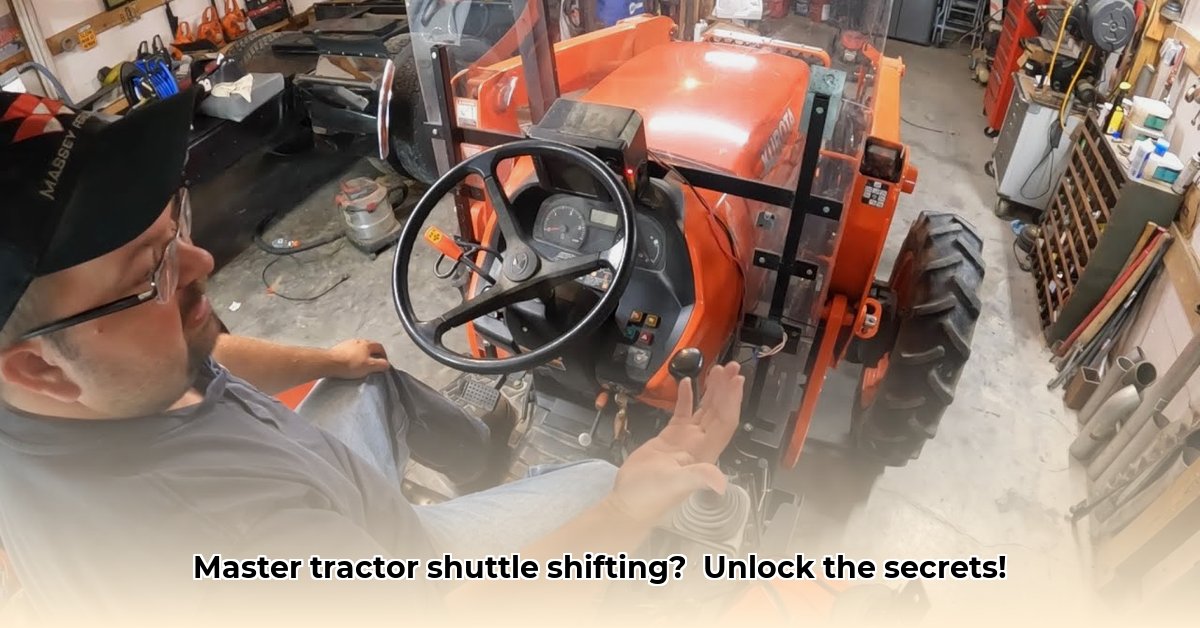
Choosing the right tractor transmission significantly impacts farm productivity and operational costs. This guide compares two leading options: shuttle shift and hydrostatic transmissions (HSTs), providing actionable advice for informed decision-making.
Understanding Tractor Shuttle Shifts: Effortless Forward and Reverse
Shuttle shift transmissions enable quick changes between forward and reverse, often without requiring clutch operation. This significantly boosts efficiency for repetitive field tasks like hay baling. Two main types exist:
Basic Shuttle Shift: A simpler, more affordable option requiring clutch use for each shift. Similar to a standard car transmission, but with a dedicated reverse mechanism.
Power Shuttle: This advanced system automates clutch disengagement during shifting, reducing operator fatigue, especially during extended periods of operation. It's essentially "cruise control" for directional changes.
Hydrostatic Transmissions (HSTs): The Smooth Operator
HSTs utilize hydraulic fluid to control both speed and direction. They offer infinitely variable speed, resulting in smooth acceleration and deceleration without jerky shifts. This makes them ideal for precision work (e.g., front-end loader operations) and confined spaces.
Shuttle Shift vs. HST: A Detailed Comparison
The following table highlights key differences to aid in your decision-making process:
| Feature | Tractor Shuttle Shift | Hydrostatic Transmission (HST) |
|---|---|---|
| Speed Changes | Discrete gears, rapid changes with power shuttle | Infinitely variable, smooth transitions |
| Efficiency | Generally higher efficiency for PTO (power take-off) power transfer | Can be less efficient, particularly under heavy loads |
| Maintenance | Typically simpler and less costly | More complex hydraulic systems, potentially higher costs |
| Initial Cost | Usually lower | Generally higher |
| Ideal Applications | Heavy-duty work, large farms, repetitive direction changes | Precision work, loader work, smaller farms, tight spaces |
Choosing the Right Transmission: Tailoring to Your Farming Style
Selecting the best transmission depends entirely on individual farming practices:
Scale of Operations: Large-scale operations benefit from the speed and efficiency of power shuttle systems for repetitive tasks like plowing extensive fields. Smaller farms might prioritize the precision of HSTs for more controlled tasks.
Type of Work: Frequent front-end loader use or tasks demanding precise speed control favor HSTs. Conversely, operations primarily involving plowing, planting, and harvesting may find shuttle shifts more time- and labor-efficient.
Budget: Consider both initial purchase price and long-term maintenance costs. While HSTs have higher upfront costs, ongoing maintenance expenses may be comparable depending on usage. Shuttle shifts often demonstrate lower long-term maintenance needs due to simpler mechanical designs.
Long-Term Considerations: Ensuring Optimal Tractor Lifespan
Both shuttle shift and HST transmissions require regular maintenance for optimal performance and extended lifespan. Regular oil changes, proper lubrication, and avoidance of overloading are crucial for both. Neglecting maintenance can result in expensive repairs and downtime. These maintenance considerations should be factored into your long-term cost analysis.
The Future of Tractor Technology: Innovation on the Horizon
Continuous advancements in tractor technology promise even more efficient power shuttle systems and highly responsive, energy-efficient HSTs. Hybrid systems combining the strengths of both types may also emerge, presenting a potentially versatile and efficient solution. Ongoing research signals exciting developments in this field.
Final Thoughts: Selecting the Ideal Transmission for Your Farm
Choosing the right tractor transmission is a critical decision. Carefully assess your typical tasks, farm size, and budget to maximize your farm's efficiency and productivity. This guide offers a framework for making an informed choice.
Key Takeaways:
- Hydrostatic transmissions excel in maneuverability and smooth operation, ideal for frequent direction changes and confined spaces.
- Shuttle shift transmissions offer robust power delivery and are generally more cost-effective upfront, excelling in large-scale, repetitive operations.
- The optimal choice depends heavily on individual farm operations, budget, and operator experience. Thorough consideration of your unique work environment is paramount.
- Maintenance requirements vary significantly. Hydrostatic systems often demand specialized expertise for repairs.
"Choosing the right transmission is a crucial decision that directly impacts productivity and long-term costs," says Dr. Emily Carter, Agricultural Engineering Professor at Purdue University. "A careful evaluation of your specific operating needs is crucial before making a final decision."